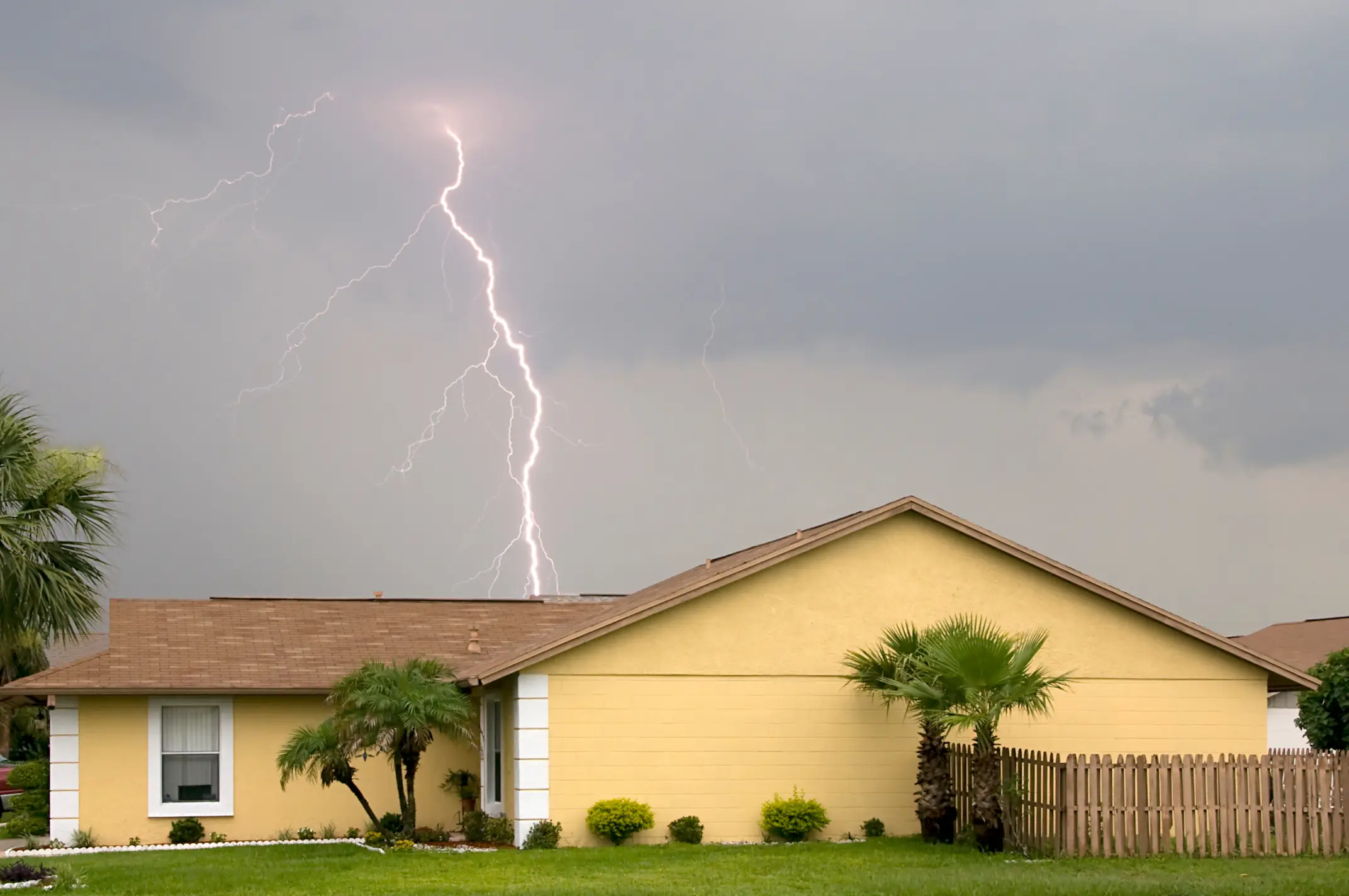
If you live in Central Florida, you already know the afternoon ritual: clear morning, towering clouds by two o'clock, and a thunderstorm that shakes the windows by four. The stretch of I-4 between Tampa and Orlando isn't just stormy — it's "Lightning Alley," the most lightning-prone region in the United States. More strikes hit here than anywhere else in the country.
That makes surge protection less of a nice-to-have and more of a baseline for a Florida home. But here's the part most homeowners get wrong: the power strip behind the TV isn't doing the job you think it is, and lightning isn't even where most of the damage comes from. Here's how whole-home surge protection actually works, what it protects, and why it belongs at your electrical panel — not just at your outlets.
What a Whole-Home Surge Protector Actually Does
A whole-home surge protective device (SPD) installs at your electrical panel — the point where power enters your home. Its job is simple to describe: when the voltage on your incoming power spikes above a safe level, the device diverts that excess energy safely to ground before it can travel down your circuits and into everything plugged into them.
Normal household voltage is steady. A surge is a brief, sharp spike above that — sometimes thousands of volts lasting a fraction of a second. That's more than enough to fry the sensitive electronics inside a modern appliance, and because the SPD sits at the panel, it catches the surge at the door rather than at each individual outlet.
Think of it as the difference between a gate at the property line and a lock on each interior door. You want both, but the gate stops the problem before it ever gets inside.
Surges Aren't Just Lightning
This is the misconception worth clearing up, because it changes how you think about the whole thing. Lightning is the dramatic cause — a nearby strike can send a massive surge through the power lines or even the ground. In Lightning Alley, that risk is real and constant through the summer.
But the majority of surge events are much smaller and come from inside your own home. Every time a large motor cycles on and off — your air conditioner's compressor, the pool pump, the refrigerator, the well pump — it creates a small voltage spike on your wiring. These happen many times a day, every day.
No single one of these internal surges will kill an appliance. The problem is cumulative: they chip away at the electronics in your HVAC system, appliances, and devices over months and years, shortening their lifespan in ways that never get traced back to the real cause. Add utility-side events — grid switching, transformer issues, power restored after an outage — and the picture is clear: your electronics are taking small hits constantly, with the occasional big one from the sky.
Whole-home protection addresses both. It's the only layer positioned to catch a large external surge, and it blunts the constant internal ones too.
Why a Power Strip Isn't Enough
Most homeowners assume they're covered because they have a few surge-protector power strips. Those have a role, but they're the last line, not the first — and on their own they leave big gaps:
- They only protect what's plugged into them. Your HVAC, water heater, pool equipment, oven, and anything hardwired have no protection at all.
- They wear out silently. The components inside a power strip degrade with every surge they absorb, and most give no indication they've stopped protecting. Plenty of "surge protector" strips are just glorified extension cords by the time they're a few years old.
- They can't handle a large surge. A point-of-use strip isn't built to absorb the energy of a nearby lightning event.
The right approach is layered: a whole-home SPD at the panel as the primary defense, backed up by quality point-of-use protectors on your most sensitive electronics. The panel device does the heavy lifting; the strips clean up what's left.
What's Actually at Risk — Including Your Biggest Investments
A generation ago, a surge might have cost you a TV. Today's home is full of electronics, and the replacement cost of a single bad surge event has climbed accordingly:
- HVAC systems — modern air handlers and heat pumps run on circuit boards that a surge can destroy, turning a spike into a four- or five-figure repair.
- Major appliances — refrigerators, ovens, washers, and dryers are all computer-controlled now.
- Electronics — TVs, computers, networking gear, smart-home devices.
- Pool automation — the control boards and variable-speed pump drives we cover in our post on pool subpanels and pool electrical are exactly the kind of sensitive equipment a surge targets.
And increasingly, the most expensive electronics in the house are the energy systems themselves. If you have — or are planning — solar, battery storage, or an EV charger, those are sophisticated pieces of power electronics. Your solar inverter, your home battery, and your EV charging equipment all represent a significant investment, and all of it is surge-sensitive. Whole-home surge protection is one of the cheapest ways to protect the priciest equipment you own — which is a big part of why we bring it up with solar and storage customers.
Why Florida Specifically
Two things stack up here. First, the lightning — no other part of the country sees the strike density of the Tampa–Orlando corridor, and every summer afternoon is another round of it. Second, the same factors we've written about elsewhere: the heat and humidity that make Florida homes run their AC and pool equipment nearly year-round mean more internal surges, more often, than a home in a milder climate.
More storms overhead and more motor-driven equipment cycling below is the exact combination whole-home surge protection is built for. It's hard to think of a market where the case is stronger.
What's Involved
A whole-home SPD is a modest device that installs at or in your main electrical panel, wired in by a licensed electrician. For most homes it's a straightforward addition — often completed in a single visit — though older panels may need evaluation first to confirm there's a safe way to integrate it.
It is not a DIY project. The device connects inside a live electrical panel, its placement and wiring affect how well it actually performs, and in most jurisdictions the work requires a permit. This is the same reasoning we give for panel and pool work: the installation quality determines whether the protection does its job, and a panel is no place to learn on the fly.
If you're not sure whether your home already has surge protection — many older Florida homes don't — it's worth having your panel looked at. It's also a natural thing to address if a panel upgrade is already on the table, since the two jobs pair naturally.
Surge Protection Across Florida
We install whole-home surge protection as part of the licensed electrical work we do across Florida — throughout the Tampa Bay area and Greater Orlando — often alongside panel upgrades, solar, or storage projects where protecting the equipment is part of doing the job right.
If you want to know whether your home is protected today, or you're adding solar, a battery, or an EV charger and want to safeguard the investment, reach out to our team and we'll take a look.
Lunex Power provides licensed electrical services throughout Florida and Massachusetts, and installs solar and home battery storage across Florida, Massachusetts, Connecticut, Rhode Island, Colorado, and North Carolina. Get in touch to talk through your project.