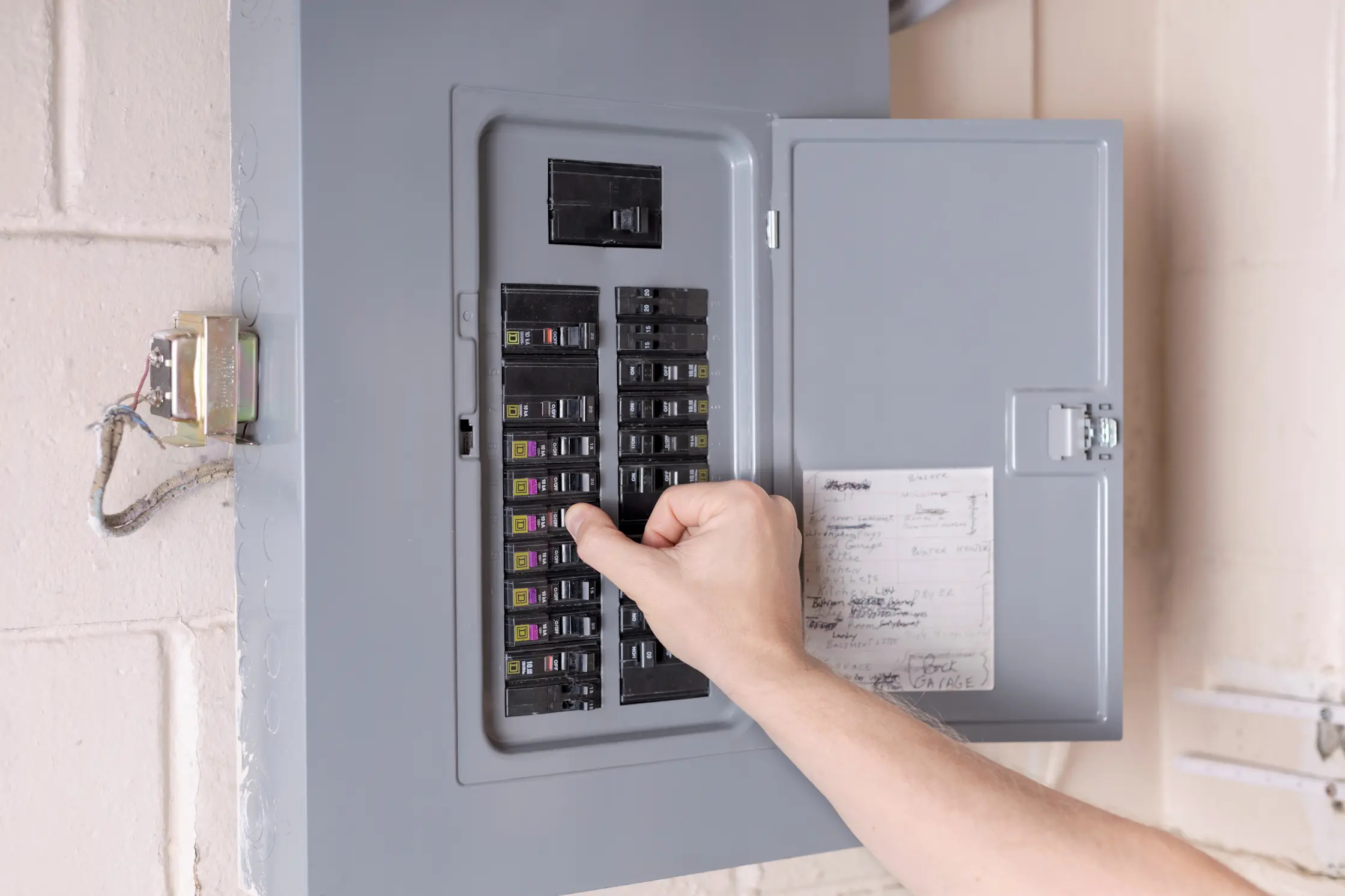
Your electrical panel is one of the most important systems in your home — and one of the least understood.
Most homeowners only open it when a breaker trips. But knowing how to read your panel can help you understand your home's electrical capacity, identify potential problems before they become serious, and have a much more informed conversation with an electrician when work is needed.
This guide walks through what everything in your panel actually means — in plain language.
What Is an Electrical Panel?
Your electrical panel — also called a breaker box, load center, or service panel — is the central hub where power from the utility enters your home and gets distributed to individual circuits.
It contains:
- A main breaker that controls power to the entire home
- A series of individual circuit breakers that protect each circuit
- Bus bars that carry current from the main breaker to the individual breakers
- A neutral bar and ground bar where neutral and ground wires terminate
Everything that uses electricity in your home — lights, outlets, appliances, HVAC — traces back to a breaker in this panel.
Where to Find Your Panel
Electrical panels are typically located in one of these places:
- Utility room or laundry room
- Garage
- Basement
- Hallway closet
- Exterior wall of the home (in a weatherproof enclosure)
In older homes, you may have more than one panel — a main panel and one or more subpanels that serve specific areas like a workshop, addition, or detached garage.
Understanding the Main Breaker
At the top of your panel — or sometimes at the bottom — is the main breaker. This is a large double-pole breaker, usually labeled with an amperage rating like 100A, 150A, or 200A.
This number tells you the total amperage capacity of your electrical service — in other words, the maximum amount of power your home can draw from the utility at once.
- 100-amp service was the standard in homes built before the 1980s. It's often undersized for modern loads.
- 150-amp service is less common but exists in some mid-century homes.
- 200-amp service is the current standard and what most modern homes require.
- 400-amp service is found in larger homes or properties with high electrical demand.
If you're planning to add solar, an EV charger, or significant new appliances, your main breaker rating is one of the first things an electrician will evaluate.
Reading the Individual Breakers
Below the main breaker are rows of smaller breakers — these are your branch circuit breakers. Each one protects a specific circuit in your home.
Breaker size
Each breaker has an amperage rating printed on it, typically 15A or 20A for standard circuits, and 30A, 40A, or 50A for larger dedicated circuits like dryers, ovens, water heaters, and EV chargers.
The breaker size tells you the maximum current that circuit is designed to carry. If the load on that circuit exceeds the breaker rating, the breaker trips — that's it doing its job.
Single-pole vs. double-pole breakers
Single-pole breakers occupy one slot and provide 120 volts. These serve most standard outlets and lighting circuits.
Double-pole breakers occupy two slots and provide 240 volts. These serve larger appliances that require higher voltage — dryers, ranges, water heaters, EV chargers, central AC units, and solar inverter connections.
If you look at your panel and see wide breakers taking up two rows, those are your double-pole circuits.
The circuit labels
Next to each breaker there should be a label describing what that circuit serves — "master bedroom," "kitchen outlets," "garage," "dryer," and so on.
In practice, these labels are often incomplete, inaccurate, or missing entirely — especially in older homes. If yours are blank or outdated, an electrician can trace and re-label each circuit as part of a panel evaluation.
What the Slot Count Tells You
The total number of breaker slots in your panel matters — not just how many are currently filled.
A standard residential panel has 20, 24, 30, or 40 slots. The number of available spaces determines whether you have room to add circuits for new loads.
If your panel is full — every slot occupied — adding a new circuit like an EV charger or solar connection requires either removing an existing circuit, installing a tandem breaker where space allows, or upgrading to a larger panel.
This is one of the most practical things to check before planning any electrical addition to your home.
Tripped Breakers and What They Mean
A tripped breaker sits in a middle position between ON and OFF — or in some panels, flips fully to OFF. To reset it, switch it fully to OFF first, then back to ON.
A breaker that trips occasionally is doing its job. A breaker that trips repeatedly is telling you something:
- Overloaded circuit — too many devices drawing power on the same circuit
- Short circuit — a wiring fault causing direct contact between hot and neutral wires
- Ground fault — current leaking to ground through an unintended path
- Failing breaker — older breakers can become unreliable over time
If a breaker trips and won't reset, or resets and immediately trips again, don't keep resetting it. That's a sign something needs to be investigated by a licensed electrician.
Warning Signs to Watch For
While you have the panel open, a few things are worth looking at:
Burn marks or discoloration around any breaker or wiring connection is a serious warning sign and warrants immediate attention.
Melted or damaged wiring insulation indicates excessive heat — a potential fire risk.
Double-tapped breakers — two wires connected to a single breaker that isn't rated for it — are a common code violation found in older panels and DIY electrical work.
Corrosion or moisture inside the panel can compromise connections over time, particularly in panels mounted on exterior walls or in humid environments.
No ground bar in very old panels can indicate outdated wiring that may not meet current safety standards.
If you notice any of these, it's worth having a licensed electrician take a look.
When to Call an Electrician
Reading your panel is something any homeowner can do. But there are situations where professional evaluation is the right call:
- You're planning to add a major new load — solar, EV charger, hot tub, addition
- Breakers are tripping frequently without an obvious cause
- Your panel is more than 25–30 years old
- You have a Federal Pacific, Zinsco, or split-bus panel
- Your home still has 100-amp service and your electrical needs have grown
- You're buying or selling a home and want to understand the panel's condition
A panel evaluation is a straightforward service — and the information it provides is useful regardless of whether any work ends up being needed.
Contact Lunex Power to schedule an electrical evaluation »
The Bottom Line
Your electrical panel is the nerve center of your home's electrical system. Understanding what's in it — the main breaker rating, the individual circuits, the available capacity, and the warning signs — puts you in a much better position to make informed decisions about your home.
You don't need to be an electrician to read your panel. You just need to know what you're looking at.