Back to Blog
Solar Panel Maintenance, Lifespan, and Warranties: What to Actually Expect
Phil Huet
9 min read
Most of the cost questions about solar get answered before the panels go up — system price, incentives, payback period. The questions that come after installation are different, and they're the ones homeowners tend to ask us once the excitement settles: Do I have to clean these? How long will they actually last? And if something breaks in year nine, who pays for it?
These are fair questions, and the honest answers are mostly reassuring — solar is one of the lowest-maintenance investments you can make in a home. But "low maintenance" isn't "no maintenance," and the warranty side has more nuance than the glossy brochures suggest. Here's what to actually expect over the 25-plus years you'll own the system.
Do Solar Panels Need Maintenance?
Solar panels have no moving parts. They sit on your roof, convert sunlight to electricity, and have no pumps, belts, or motors to wear out. That's the core reason maintenance demands are so low compared to almost any other major home system.
For most homeowners, ongoing maintenance comes down to a few things:
Cleaning
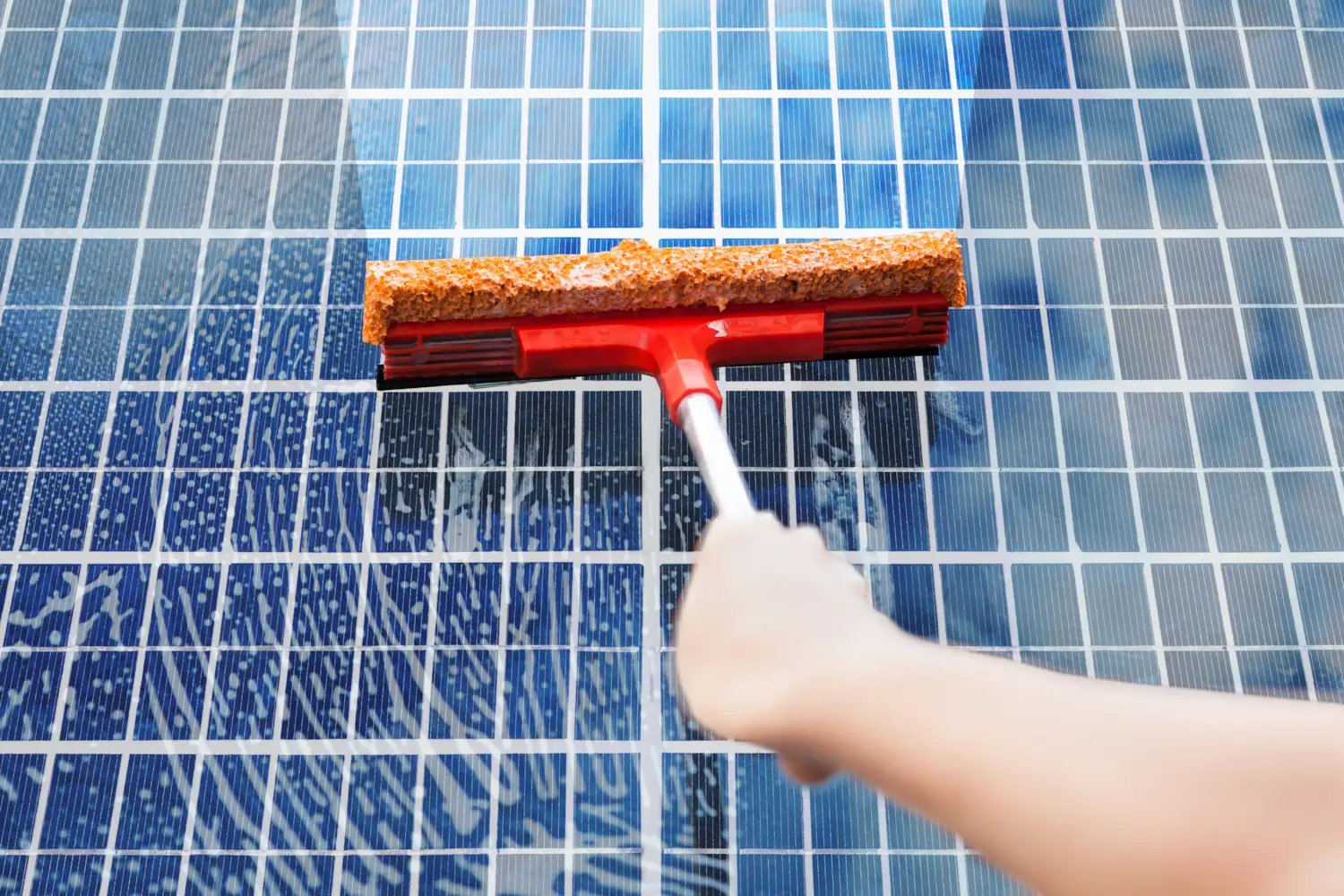
In most climates, rain does the majority of the cleaning for you. Panels are installed at a tilt, so water sheets off and carries dust and pollen with it. Independent studies have generally found that routine cleaning recovers only a few percent of output in typical residential conditions — not nothing, but rarely worth paying a service to do regularly.
Cleaning matters more if you're in a dry, dusty region with long stretches between rain, near agricultural operations, under heavy tree cover that drops pollen and sap, or in an area with significant bird activity. If you notice a persistent dip in production during a dry spell, that's the signal to rinse them down — usually nothing more than a hose from the ground. Climbing on your roof to scrub panels is generally not recommended, both for your safety and the panels'.
Monitoring
This is the maintenance task that actually matters, and it's largely automated. Every modern system comes with a monitoring app that shows your production. The point isn't to admire the graphs — it's to catch a problem early. If one panel or one section of the array stops producing, the app will show it long before you'd ever notice it on your utility bill. Checking in once a month is plenty.
Seasonal and storm-related attention
Snow typically slides off tilted panels on its own once the sun hits them, and clearing it manually is rarely worth the risk. After a major storm, a quick visual check from the ground — looking for shifted panels, debris, or anything obviously damaged — is a reasonable habit, especially for coastal homeowners. Beyond that, an occasional professional inspection (every few years, or if your monitoring flags something) covers the rest.
What Actually Needs Attention Over Time
Here's the part that's worth being straight about: it's usually not the panels.
The panels themselves are the most durable part of the system. The component most likely to need service or replacement during the system's life is the inverter — the device that converts the DC electricity your panels produce into the AC electricity your home uses. Inverters do the most work and run the most hours, so they're the most common point of eventual service.
How that plays out depends on your inverter architecture, which is worth understanding before you buy. String inverters are a single central unit; microinverters and optimizers are distributed across the array. Each approach handles failure and replacement differently. We break down the tradeoffs in detail in our comparison of Enphase, SolarEdge, and Tesla Powerwall 3 inverter systems, but the short version is that this is the component whose warranty length and reliability deserve the most scrutiny.
If you've added a battery, that's the other component with a defined service life — more on battery warranties below.
How Long Do Solar Panels Last?
A quality residential solar panel is built to produce meaningful power for 25 to 30 years, and often well beyond. The 25-year mark is a warranty milestone, not an expiration date. Plenty of systems installed in the 1990s and early 2000s are still generating today, just at somewhat reduced output.
That word — reduced — is the key to understanding panel lifespan. Panels don't typically fail outright at year 25 and go dark. Instead, they slowly produce a little less each year. Which brings us to degradation.
Understanding Degradation
Degradation is the gradual decline in a panel's output over time, caused by normal exposure to sunlight, heat, and weather. It's measured as an annual percentage.
Modern panels degrade slowly. A common figure for quality panels is roughly 0.5% per year, sometimes less for premium tiers, after a slightly larger drop in the first year. That number sounds abstract, so here's what it means in practice:
- A panel rated at 100% output when new
- Losing about 0.5% per year
- Is still producing roughly 87–90% of its original output after 25 years
In other words, a system that offsets nearly all of your electricity bill on day one will still be offsetting the large majority of it decades later. Degradation is real, but it's slow and predictable — and good system design accounts for it. This is also why a payback estimate built on a 25-year horizon holds up: the small annual decline is far outweighed by rising utility rates over the same period, something we walk through in our breakdown of the solar payback period.
Solar Warranties, Explained
This is where homeowners get the least clear information, because "the warranty" is actually several separate warranties that cover different things and come from different parties. There are three you should understand on the panels alone, plus separate coverage for the inverter and any battery.
1. Product (Equipment) Warranty
This covers the physical panel itself against manufacturing defects and premature failure. If a panel fails because of how it was built — not because of storm damage or improper installation — this is the coverage that applies.
Product warranties on quality panels typically run 12 to 25 years, and the length has been climbing. A longer product warranty is one of the clearest signals of how much faith a manufacturer has in their own hardware.
2. Performance (Power) Warranty
This is the one that addresses degradation. The manufacturer guarantees the panel will still produce at least a certain percentage of its rated output at specific points in time — most commonly at least 80–87% after 25 years. If your panels degrade faster than the guaranteed curve, the performance warranty is what you'd claim against.
Two panels can have the same 25-year performance warranty but different guaranteed percentages at year 25. Reading that number — not just the year — tells you how good the panel actually is.
3. Workmanship (Installation) Warranty
This one doesn't come from the panel manufacturer — it comes from your installer. It covers the labor and the installation itself: roof penetrations, wiring, mounting, and the things that have nothing to do with the panel hardware and everything to do with how the system was put on your house. Workmanship warranties commonly range from 10 to 25 years.
This is the warranty most worth paying attention to, because it's the one that depends entirely on who you hire — and the one that's only as good as the company standing behind it. A 25-year workmanship warranty means nothing if the installer isn't around in year 12 to honor it. It's a big part of why we think working with an established local installer versus a national chain matters more than most people realize when they're comparing quotes.
Inverter and Battery Warranties
Because the inverter is the component most likely to need eventual service, its warranty deserves a direct look. String inverter warranties often run 10–12 years (extendable), while microinverter warranties commonly reach 25 years — a meaningful difference over the life of the system.
If your system includes storage, the battery carries its own warranty, typically defined by a 10-year term and/or a throughput/cycle guarantee, often with a retained-capacity figure (for example, guaranteeing a certain percentage of original capacity at year 10). We get into how the major options compare in our home battery comparison.
What Can Void a Warranty
Warranties have limits, and the common ways homeowners run into trouble are worth knowing up front:
- Unauthorized work. Having someone other than a qualified professional modify, repair, or even remove and reinstall the system (for a roof replacement, say) can void coverage if it's not done correctly.
- Improper installation. A poorly mounted system can void the panel manufacturer's warranty entirely — another reason the workmanship side matters so much.
- Damage outside normal use. Most warranties cover defects and degradation, not damage from extreme events. Whether storm or impact damage is covered usually falls to your homeowner's insurance, not the solar warranty.
- Letting registration lapse. Some manufacturers require the system to be registered after installation for the full warranty term to apply. A reputable installer handles this for you.
What This Means for Your Long-Term Costs
Put it all together and the ownership picture for solar is unusually simple. The recurring costs are minimal — occasional cleaning in some climates, a few minutes a month glancing at a monitoring app, and an inspection every few years. The panels themselves are likely to outlast the warranty. Degradation is slow and predictable. The one component you may replace during the system's life is the inverter, and a strong warranty on it limits that exposure.
The variable that's most in your control isn't the hardware — it's choosing an installer whose workmanship warranty will actually be honored years from now, and who installs the system correctly enough that you never need to test the manufacturer warranties in the first place.
If you'd like a straight answer on the specific warranties behind the equipment we install, what's covered, and for how long, reach out to our team. We're happy to walk through the fine print before you commit to anything.
Lunex Power installs solar panel systems and home battery storage across Florida, Massachusetts, Connecticut, Rhode Island, Colorado, and North Carolina. Get a free quote to see what the numbers look like for your home.