Power outages aren't a question of if — they're a question of when. In Florida and across the Southeast, hurricane season and summer thunderstorms are the primary culprits, and outages can stretch for days. In New England, nor'easters, ice storms, and heavy snow bring their own brand of grid disruption — often in the middle of winter when losing heat is more than an inconvenience. The causes differ by region, but the result is the same: homes without power, sometimes for an extended period.
When that happens, you have two main options for keeping your home running: a whole home standby generator or a home battery backup system. Both work. Both have real advantages. And both have meaningful limitations that most sales conversations gloss over.
We install both at Lunex Power. This is our honest breakdown of how they compare.
Not sure which is right for your home? Contact our team for a free consultation »
Quick Comparison
| Whole Home Generator | Home Battery Backup | |
|---|---|---|
| How it works | Burns natural gas or propane to generate electricity | Stores electricity from solar or grid, discharges during outage |
| Backup duration | Unlimited (as long as fuel supply continues) | Limited to stored capacity — extended by solar |
| Startup time | 10–30 seconds after outage | Near-instant (milliseconds) |
| Power output | 10–22+ kW continuous | Varies by system — typically 10–15 kW per unit |
| Fuel source | Natural gas, propane, or diesel | Solar panels or grid electricity |
| Noise | Significant — similar to a running lawn mower | Silent |
| Emissions | Yes — combustion exhaust | None |
| Maintenance | Annual service required, ~$200–$400/year | Minimal — no moving parts |
| Typical installed cost | $8,000–$16,000 | $15,500+ per battery |
| Lifespan | 15–30 years | 10–15 years |
| Incentives | Generally none | State and utility rebates may apply |
How a Whole Home Standby Generator Works
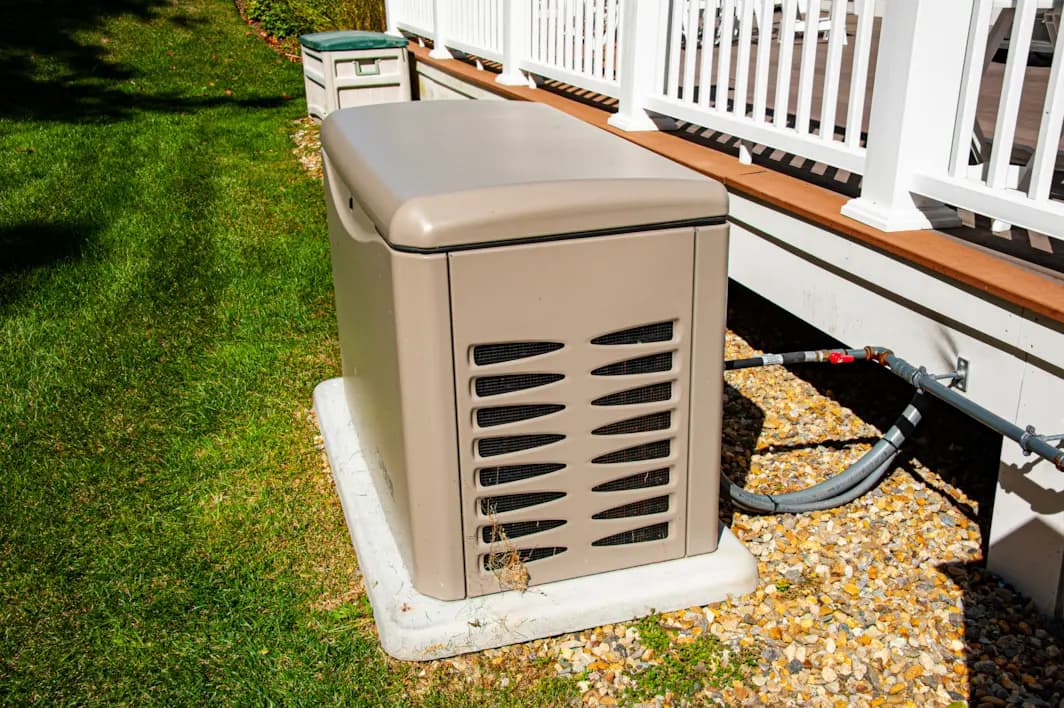
A whole home standby generator is a permanently installed unit, typically mounted outside on a concrete pad, connected directly to your home's electrical panel and a fuel source — usually natural gas or propane.
When the grid goes down, the generator detects the outage automatically and starts within 10 to 30 seconds. A transfer switch isolates your home from the grid and routes generator power to your circuits. When utility power returns, the system switches back automatically.
The defining characteristic of a generator is its relationship to fuel. As long as natural gas is flowing from the utility line — or you have propane in a tank — the generator runs. That means days or even weeks of continuous backup during extended outages, which is a capability no battery system can match without solar recharging.
How a Home Battery Backup System Works
A home battery system stores electrical energy — either from solar panels or from the grid during off-peak hours — and discharges that stored energy to power your home when the grid goes down.
Modern residential batteries like the Franklin aPower 2, Tesla Powerwall 3, and Enphase IQ Battery 10C switch to backup mode nearly instantaneously when an outage occurs, typically within milliseconds. There's no startup delay, no noise, and no combustion.
The limitation is capacity. A single battery holds 10–15 kWh of usable energy. How long that lasts depends entirely on your home's consumption. A home running essential loads — refrigerator, lights, internet, some outlets — might get 12–24 hours from a single battery. A home running central AC will drain it much faster.
Pairing batteries with solar panels changes the equation significantly. A properly sized solar-plus-storage system can recharge the batteries each day, extending backup capability indefinitely as long as the sun keeps producing.
The Real Tradeoffs
Backup Duration
This is the generator's clearest advantage. Connected to a natural gas line, a standby generator can run for weeks without interruption. For homeowners in hurricane-prone areas where outages can stretch to 10–14 days, that runtime is genuinely difficult to replicate with batteries alone.
Battery backup duration is finite — but the gap narrows considerably when solar is in the picture. A home with a well-sized solar array and two or three batteries can maintain essential loads indefinitely through a typical Florida storm outage where the sun returns within a day or two. The challenge is extended multi-day cloudy periods, which are less common but do happen.
Upfront Cost
Generators have the lower upfront cost. A whole home standby generator runs $8,000–$16,000 fully installed depending on the size of the unit, fuel type, distance from the panel and gas line, and local permitting requirements. For whole-home backup capacity, that's a meaningful price advantage over batteries.
A single home battery starts at $15,500 installed, and most whole-home backup scenarios require two or more. A full solar-plus-storage system capable of covering all your home's loads will typically run $25,000–$50,000 depending on solar array size and battery count.
Long-Term Cost of Ownership
The generator's upfront advantage narrows over time. Annual maintenance runs $200–$400 per year for a standby generator, and fuel costs add up during extended outages or regular exercise cycles. Over 20 years, the total cost of ownership for a generator is meaningfully higher than the purchase price suggests.
Batteries have minimal ongoing costs — no fuel, no annual service, no moving parts to wear out. When paired with solar, they can also reduce your monthly utility bill outside of outages, which generators cannot do.
Noise and Emissions
A running standby generator is loud — comparable to a lawn mower operating continuously outside your home. This matters at night, and it matters for neighbors in close proximity. HOA noise restrictions are common in suburban communities, and a generator running through a multi-day outage can become a real point of friction.
Battery systems operate silently and produce zero emissions. For homeowners with medical equipment, light sleepers, or neighbors in close proximity, this difference is significant.
Startup Time
Generators take 10–30 seconds to start after an outage. That's fast enough for most purposes, but sensitive electronics — computers, medical equipment, certain appliances — can be affected by even a brief interruption.
Batteries switch over in milliseconds. If you've ever experienced a generator-backed home and noticed lights flicker when power transfers, battery systems eliminate that entirely.
Maintenance
Generators require annual professional servicing — oil changes, spark plug replacement, filter checks — plus periodic exercise runs to keep the engine in working order. This is an ongoing commitment and cost.
Batteries require virtually no maintenance. There are no moving parts, no fluids, and no exercise cycles required.
Solar Integration
This is where the two options diverge most sharply in terms of long-term value. Batteries are designed to work with solar — they're the storage side of a solar energy system, and pairing them unlocks daily energy savings, time-of-use optimization, and potentially indefinite backup during outages.
Generators provide no value outside of outages. They don't reduce your electric bill, don't interact with solar production, and don't benefit from the sun.
If you have solar or are planning to go solar, batteries integrate naturally. If you're purely focused on outage protection and don't have solar, a generator may offer a more cost-effective path to whole-home coverage.
What About Using Both?
The generator vs battery framing is useful for comparison, but the most resilient setups often use both together. A solar-plus-battery system handles short outages silently and efficiently, while a generator serves as a backup for extended multi-day events when the battery is depleted and the sun isn't recharging it.
The Franklin aPower 2 is particularly well-suited for this hybrid setup — its aGate controller has a dedicated generator port that can automatically start a generator when battery charge drops below a set threshold, then shut it off when solar recharges the system. This creates a true microgrid that covers both short outages and extended events without requiring manual intervention.
Pricing Summary
Whole Home Standby Generator
Fully installed costs typically run $8,000–$16,000 depending on generator size (kW rating), fuel type, distance from the electrical panel and gas meter, and local permitting. Propane installations require a separate tank if one isn't already on the property, which adds $500–$2,500 to the project cost. Annual maintenance runs $200–$400.
Home Battery Backup
Single battery systems start at $15,500 installed. Expansion batteries start at $9,500 each once the primary system is in place. Most whole-home backup scenarios require two or more batteries. Solar panel costs are separate and vary by system size and roof configuration.
Neither battery systems nor standard standby generators currently qualify for the federal Investment Tax Credit as of 2026. State and utility incentives for batteries vary — Massachusetts, Colorado, and North Carolina have active programs. Check with your installer for incentives available in your specific location.
Contact Lunex for a quote on either system »
How to Choose
Choose a whole home generator if:
- You experience frequent extended outages (5+ days) and don't have solar
- You want the lowest upfront cost for whole-home backup coverage
- You're on a property with reliable natural gas service
- Runtime during prolonged outages is your primary concern
Choose battery backup if:
- You have solar panels or are planning to install them
- You want backup power that also reduces your daily electricity bill
- Noise and emissions are a concern — HOA restrictions, close neighbors, or personal preference
- Your outages are typically short (1–3 days) and you want seamless, instant switchover
Consider both if:
- You're in a hurricane-prone area where extended multi-day outages are realistic
- You want the efficiency and daily savings of solar-plus-storage with the long-duration insurance of a generator
- You want the most resilient backup setup possible regardless of outage length
The Honest Bottom Line
Generators win on runtime and upfront cost. Batteries win on noise, emissions, maintenance, solar integration, and daily energy value. Neither is universally better — the right choice depends on how long your outages typically run, whether you have solar, what your budget looks like, and how much the ongoing costs and noise of a generator factor into your decision.
For many Florida homeowners, especially those going solar, a battery-first approach with a generator as a backup-of-last-resort is the most practical and cost-effective path. For homeowners focused purely on outage protection — especially those who've experienced extended hurricane outages — a generator still makes a compelling case.
Our team installs both and can help you think through which setup makes sense for your home and market.