Back to Blog
How Lunex Direct Builds Your Solar Design — Without a Salesperson
Phil Huet
Updated:
9 min read
How Lunex Direct Builds Your Solar Design — Without a Salesperson
For years, getting a solar quote meant inviting a stranger into your home. They'd walk your roof, measure your panels, review your utility bills, and then — after an hour-long presentation — hand you a number. If you wanted to compare quotes, you'd do it all over again with the next company. The whole process could stretch across weeks.
Lunex Direct was built to eliminate that friction entirely.
It's Lunex Power's self-service solar design tool, and it generates a complete, accurate proposal for your specific home — roof layout, system size, production estimates, equipment options, and pricing — in about 90 seconds. No appointment. No sales call. No one sitting across your kitchen table.
But the reason it works isn't magic. It's data. Here's exactly what's happening behind the scenes when Lunex Direct builds your solar design.
Step 1: Your Address Pulls a Detailed Picture of Your Roof
The moment you enter your address, Lunex Direct begins assembling a precise model of your home using two distinct data sources.
Satellite Imagery
High-resolution overhead imagery gives the system an accurate top-down view of your roof — its shape, approximate dimensions, and any visible obstructions like skylights, HVAC equipment, vents, or chimneys. This is the same imagery layer that would previously require a technician to verify in person.
LiDAR Roof Measurement
Satellite imagery tells the tool what is on your roof. LiDAR tells it exactly how your roof is shaped.
LiDAR — Light Detection and Ranging — works by bouncing laser pulses off surfaces and measuring the time it takes for them to return. The result is a precise three-dimensional point cloud of your roof: every pitch angle, every ridge and valley, every elevation change. This is the same technology used in autonomous vehicles and high-accuracy topographic mapping.
Why does roof pitch matter for solar? Because the angle at which panels face the sun directly affects how much energy they produce. A south-facing roof at a 22–30° pitch is close to optimal for most Florida latitudes. A shallow pitch or a roof plane that faces east or west generates measurably less from the same equipment. Without LiDAR, these differences are estimated. With it, they're measured.
This is data that used to require someone physically on your roof. Lunex Direct pulls it remotely, before you've spoken to anyone.
Step 2: Shading Is Modeled Across the Entire Year — Not Just Right Now
One of the most common errors in solar proposals is treating shading as a snapshot rather than a variable. A roof plane that looks unobstructed in a summer noon satellite photo may be significantly shaded by trees, a chimney, or a neighboring structure during morning hours or winter months when the sun sits lower in the sky.
Lunex Direct accounts for this using sun-path modeling — a simulation of how the sun moves across your specific location at every hour of every season. Combined with the three-dimensional roof model from LiDAR, the tool calculates how shadows fall across each roof segment throughout the year, not just at a single moment.
This shading analysis has a direct effect on where panels are placed in your design. Roof segments with poor annual sun exposure are excluded or deprioritized. The panels that appear in your layout are positioned where they'll actually produce energy — a level of precision that previously required a site visit from an experienced solar engineer.
Step 3: Your Utility Bill Sets the Right System Size
Once the roof model is established, Lunex Direct turns to your energy consumption to determine the right system size for your home.
You provide your average monthly electric bill and your desired offset — the percentage of your consumption you want solar to cover. Common targets are 80%, 100%, or higher if you're planning to add an EV or transition away from a gas appliance.
From there, the tool calculates system size using your utility's actual rate structure, including any tiered pricing, time-of-use rates, or net metering policies in effect in your area. Net metering — the policy that allows homeowners to sell excess solar energy back to the grid — varies significantly by utility and has a major effect on the financial case for solar. Lunex Direct incorporates current local policies into the savings calculation automatically.
The result is a system size recommendation calibrated to your actual usage and your actual utility, not a generic national average. This is a calculation that, in the traditional sales process, would happen at the end of a lengthy consultation. With Lunex Direct, it's resolved before you've talked to anyone.
Step 4: You Choose Your Equipment — On Your Own Terms
This is the part of the process that most homeowners never get to experience without a salesperson present. Lunex Direct puts the equipment decisions in your hands, with real-time cost and savings updates as you make each selection.
Solar Panels (Modules)
You can choose from multiple panel tiers. Higher-efficiency panels produce more energy from the same roof area — a meaningful consideration if your usable roof space is limited. The trade-off is upfront cost. Lunex Direct shows you both the production difference and the price difference so you can make an informed decision, not one nudged by a sales commission.
Inverter Type
The inverter is what converts the DC electricity your panels generate into the AC electricity your home uses. Your choice here matters more than most homeowners realize:
- String inverters convert power from multiple panels as a group. They're reliable and cost-effective for roofs with consistent sun exposure, but if one panel in the string is shaded, it reduces output from all of them.
- Microinverters are installed on each individual panel and convert power independently. This means shading on one panel doesn't affect the others — a significant advantage for roofs with any tree coverage, multiple orientations, or complex geometry. Microinverters also make monitoring more granular, letting you see production data panel by panel.
- Hybrid inverters are designed to work with battery storage, managing power flow between panels, batteries, and the grid.
In a traditional sales appointment, inverter selection is often guided by what the installer prefers to sell. In Lunex Direct, you see the options, the trade-offs, and the price difference side by side.
Battery Storage
Adding a battery changes the economics and the resilience profile of your system. With a battery, excess solar energy is stored for use after dark or during a grid outage rather than exported to the utility. In Florida, where hurricane season makes grid reliability a real concern for many homeowners, backup capability carries real value beyond the financial case.
Lunex Direct includes battery options with updated pricing so you can see exactly what storage adds to your project cost and your independence from the grid.
EV Charger
If you drive an EV or are planning to, pairing a Level 2 charger installation with your solar project is often more cost-effective than doing it separately. Lunex Direct includes this as an optional add-on with pricing included in the proposal.
Every selection you make updates your estimated bill reduction, annual savings, and total project cost in real time. You're making the same decisions that used to happen inside a sales presentation — but at your own pace, with no pressure and no one waiting for you to sign.
What Your Finished Proposal Includes
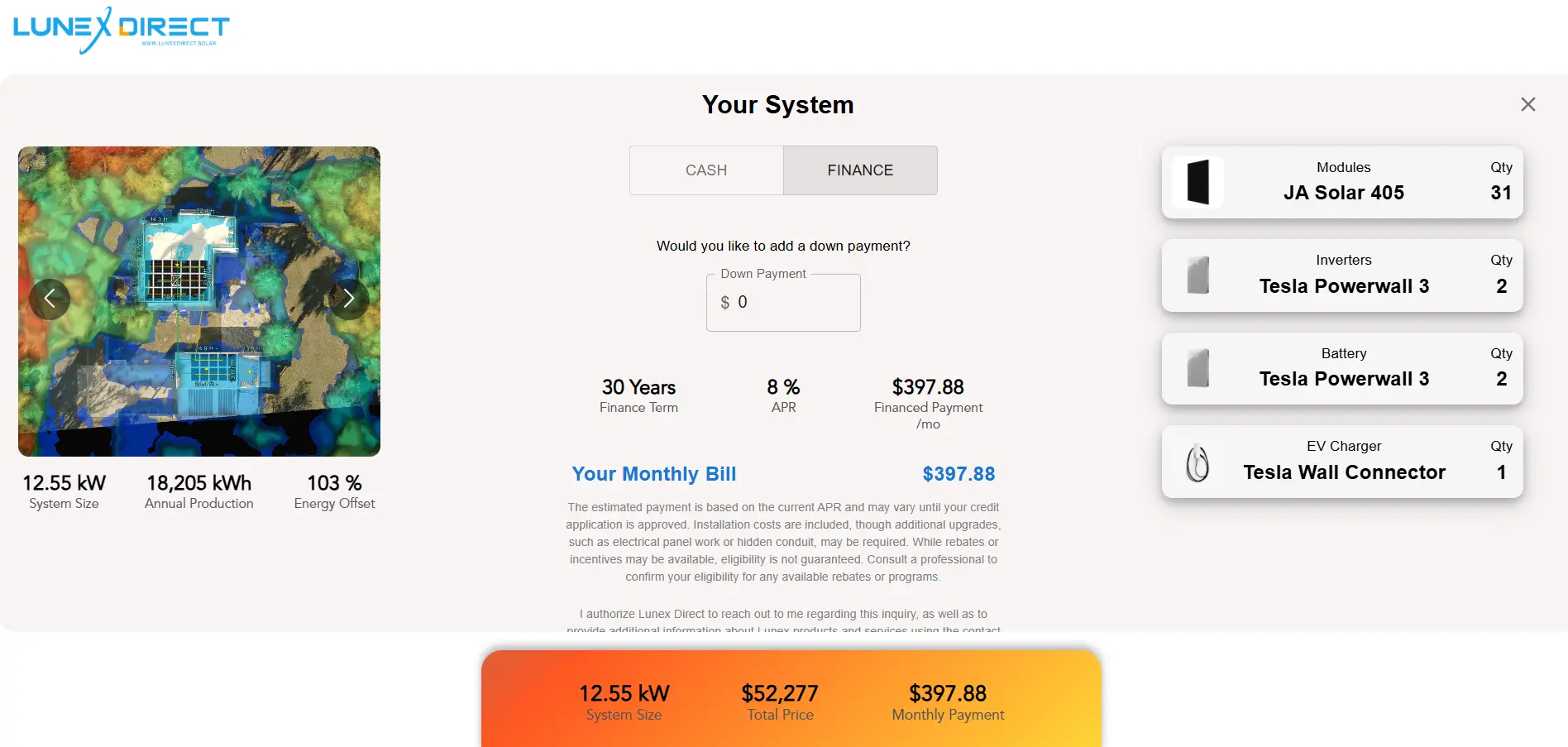
After roughly 90 seconds of data processing — pulling from the imaging APIs, shading models, equipment specs, and utility rate database simultaneously — your Lunex Direct proposal is ready.
It includes:
- Roof layout with panel placement shown on your actual property
- System size in kilowatts and estimated annual energy production in kWh
- Offset percentage — what share of your current consumption the system covers
- Total project cost including all equipment and installation
- Financing options — lease and loan pricing with monthly payment breakdowns
- Battery and EV charger pricing if selected
- Estimated utility bill reduction and long-term savings projection
You can download the proposal, review it at your own pace, and share it with whoever you want. If you want to go deeper on any of the numbers or compare equipment configurations, a Lunex engineer is available — but on your timeline, not as a prerequisite to seeing your design.
What Happens After the Proposal
The Lunex Direct proposal is a highly accurate preliminary design — the same data-driven foundation that a traditional sales appointment would eventually produce, just available immediately and without the friction.
Before installation, Lunex's engineering team reviews and finalizes the design, confirms roof condition and electrical panel capacity, and manages permitting. Changes from the preliminary design are possible but uncommon for straightforward residential systems.
The proposal is not a binding contract. There's no account required to generate one, and no obligation to move forward.
Frequently Asked Questions
How accurate is a Lunex Direct proposal compared to an in-person assessment? For system sizing and production estimates, the remote design is typically within 5–10% of what a physical site visit produces. The main variables that require in-person confirmation are roof condition and electrical panel capacity — both of which are reviewed by the Lunex engineering team before installation begins.
Why does the design take about 90 seconds? The tool is simultaneously pulling satellite imagery, LiDAR measurements, shading models, equipment specs, and utility rate data from multiple APIs. The wait reflects real computation, not a loading animation. A design that comes back instantly is likely skipping some of these steps.
Do I need to know my exact monthly kWh usage? No. Your average monthly bill amount is sufficient. The tool calculates estimated consumption from your bill and local utility rates.
What if I want to adjust my design after seeing the proposal? You can modify equipment selections and offset percentage within the tool and regenerate your proposal. If you want to explore a significantly different system design or have questions about your specific roof layout, a Lunex engineer can walk through the proposal with you.
Try It From Your Couch
Most homeowners spend weeks navigating the solar sales process before they see a real number. Lunex Direct compresses that to 90 seconds — and lets you do it on a Sunday morning in your pajamas, or on your lunch break, or whenever you're ready.
Your roof data, your utility rates, your equipment choices, your proposal. No appointment required.
👉 Build your design at app.lunexdirect.solar
Lunex Power installs residential and commercial solar, battery storage, and EV charging infrastructure across Florida. Questions about your proposal? Contact our team.