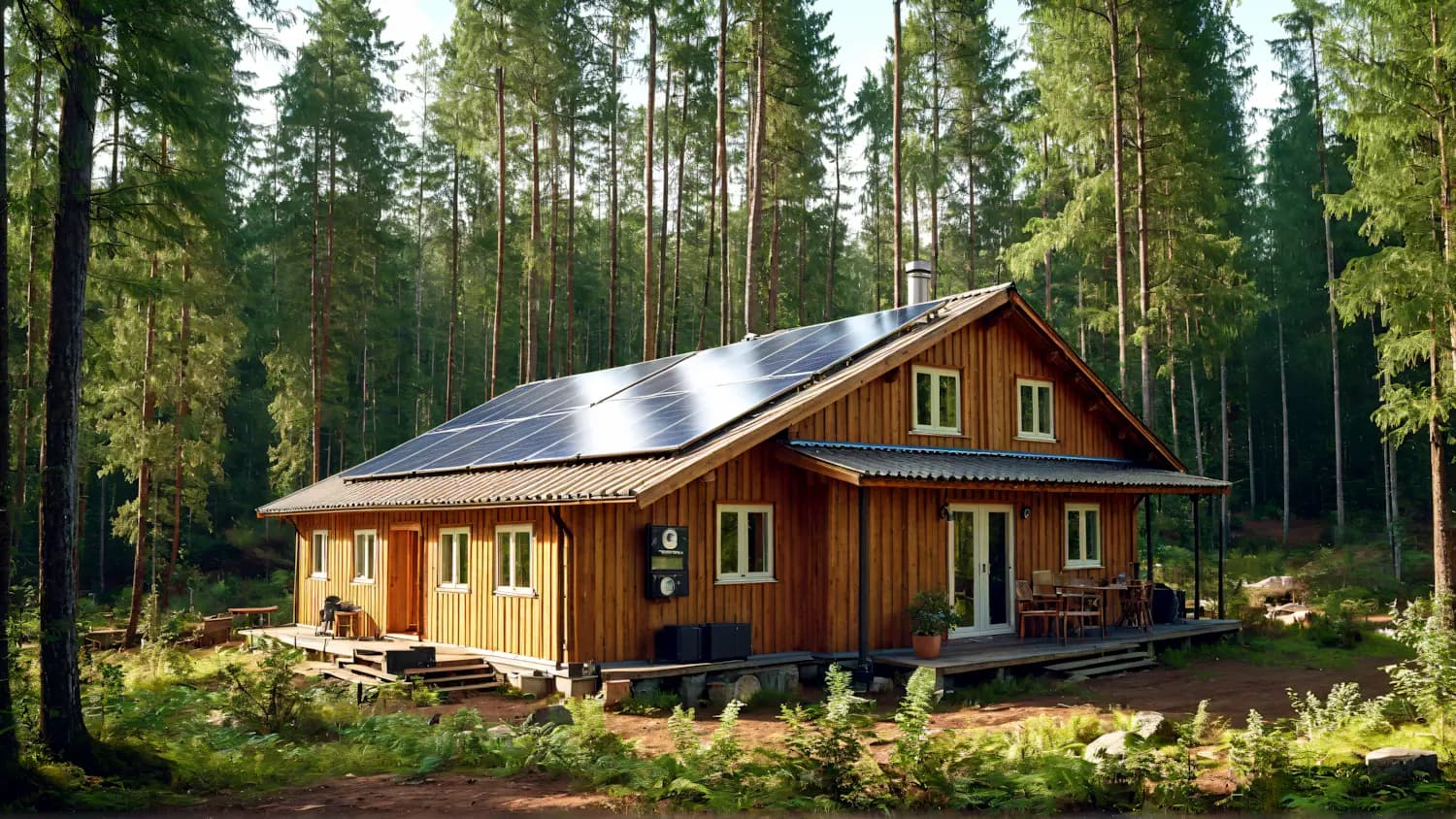
Going off grid is one of the most common goals we hear from homeowners exploring solar — and one of the most misunderstood.
Most people start by asking: how many solar panels do I need?
That's actually the wrong starting point. Panel count is the output of a system design, not the input. Before you can size a solar array, you need to understand your energy consumption, your location's solar resource, and how much storage you need to get through periods without sun.
This guide walks through the key variables that determine off-grid system size — not to give you a DIY calculator, but to help you understand what goes into the design so you can have a more informed conversation with your installer.
Contact us to discuss off-grid solar for your property »
Step 1: Start With Your Daily Energy Usage
The foundation of any off-grid system design is your daily energy consumption, measured in kilowatt-hours (kWh).
For a grid-tied home, this number is easy to find — it's on your utility bill. For a new off-grid build or a property that has never been connected to the grid, it requires an appliance-by-appliance load analysis.
Common contributors to daily energy load include:
- HVAC — heating and cooling are typically the largest load in most climates
- Water heating — electric water heaters draw significant power
- Refrigeration — runs continuously, so even modest wattage adds up
- Lighting — LED fixtures have dramatically reduced this load
- Well pump — a major consideration for rural off-grid properties
- Electronics and appliances — computers, TVs, washers, and dryers
A modest off-grid home might average 10–20 kWh per day. A larger home with electric heating, an EV, or energy-intensive appliances could easily exceed 40–50 kWh per day. The number varies enormously by lifestyle, climate, and how aggressively the homeowner has managed their loads.
This daily energy number is the anchor for everything else in the system design.
Step 2: Factor In Your Location's Peak Sun Hours
Solar panels don't produce the same amount of power everywhere. The amount of usable solar energy your location receives is measured in peak sun hours — a standardized way of expressing daily solar irradiance.
Peak sun hours vary significantly by geography and season:
- Southwestern states like Arizona, New Mexico, and Colorado see 5.5–7+ peak sun hours per day annually
- The Southeast and Mid-Atlantic average around 4.5–5.5 hours
- The Northeast and Pacific Northwest can drop to 3.5–4.5 hours, with significant seasonal variation
For off-grid design, engineers typically size systems around worst-case months — usually December or January — rather than annual averages. A system sized for summer sun will leave you short in winter, which is when most off-grid failures happen.
Your location's peak sun hours directly affect how large your solar array needs to be to meet your daily load.
Step 3: Size the Solar Array
Once you know your daily energy need and your location's worst-month peak sun hours, you can estimate the solar array size needed to meet that load.
As a simplified illustration:
- A home using 20 kWh per day in a location with 4 peak sun hours in winter needs a system capable of producing at least 20 kWh during those 4 hours of useful generation
- That works out to roughly 5 kilowatts (kW) of solar capacity at minimum — before accounting for system losses
In practice, off-grid systems are sized with a safety margin above the bare minimum to account for:
- Panel degradation over time
- Inverter and wiring losses (typically 15–25% of total production)
- Cloudy days and seasonal variation
- Future load growth
A well-designed off-grid system for that same 20 kWh/day home in a moderate sun location might realistically require 8–12 kW of solar panels once those factors are applied.
Step 4: Determine Battery Storage Capacity
Solar panels only produce power when the sun is shining. For a truly off-grid system, battery storage is what bridges the gap — covering nighttime usage, cloudy days, and periods of high demand.
Off-grid battery sizing is typically expressed in terms of days of autonomy: how many days of normal usage the battery bank can cover without any solar input.
Most off-grid designs target 2–4 days of autonomy, depending on:
- How many consecutive cloudy days are typical for the location
- Whether a backup generator is part of the system
- The homeowner's tolerance for load management during low-production periods
For a home using 20 kWh per day with a target of 3 days of autonomy, that's 60 kWh of usable battery capacity before accounting for depth of discharge limits.
Battery chemistry matters here too. Lithium iron phosphate (LiFePO4) batteries — the current standard for off-grid residential systems — typically allow 80–90% depth of discharge, which means a 75 kWh battery bank might deliver around 60 kWh of usable capacity.
Lead-acid batteries, while less expensive upfront, are limited to around 50% depth of discharge and have a significantly shorter cycle life, making them less cost-effective over time for most off-grid applications.
Step 5: Don't Forget the Inverter and Charge Controller
Two additional components complete the off-grid system:
The inverter converts DC power from the panels and batteries into the AC power your home uses. For off-grid systems, this is typically a hybrid inverter or inverter-charger that manages both solar input and battery charging simultaneously. Inverter sizing must account for your peak instantaneous load — not just your average daily usage.
The charge controller regulates the flow of power from the panels to the batteries, protecting the battery bank from overcharging. MPPT (Maximum Power Point Tracking) charge controllers are the current standard and meaningfully improve energy harvest compared to older PWM designs.
Both components need to be sized to match the rest of the system — undersized inverters and charge controllers are a common cause of off-grid system underperformance.
What Does This Look Like in Practice?
To put it together: a moderately sized off-grid home in the Southeast with a 25 kWh/day load, 4.5 peak sun hours in winter, and a target of 3 days of autonomy might require:
- 10–14 kW of solar panels
- 75–100 kWh of battery storage
- A hybrid inverter sized for peak load
- A backup generator for extended low-production periods
That's a substantial system — and the numbers shift considerably based on location, lifestyle, and load management. A property in Arizona with the same daily usage would need meaningfully less panel capacity than one in Massachusetts.
This is why off-grid system sizing isn't something that can be accurately done with a generic online calculator. The variables interact in ways that require real engineering judgment and site-specific analysis.
What Does an Off-Grid Solar System Cost?
Off-grid systems are more expensive than grid-tied systems of equivalent panel capacity — primarily because of the battery bank and the additional components required to manage a self-contained energy supply.
As a general benchmark, fully installed off-grid systems typically run in the range of $3–$5 per watt of solar capacity, inclusive of panels, batteries, inverter, charge controller, and installation. That figure shifts based on battery size, equipment quality, site complexity, and labor costs in your area.
Using the example from above — a system requiring 10–14 kW of solar capacity — that benchmark puts the installed cost somewhere in the range of $30,000–$70,000 for a moderately sized off-grid home.
That's a wide range, and intentionally so. The battery bank alone can swing a project cost by tens of thousands of dollars depending on how many days of autonomy are built into the design. A system with a backup generator and 2 days of autonomy costs considerably less than one designed to run independently through a full week of overcast weather.
The most accurate way to understand what your specific project will cost is a site evaluation and load analysis — which is exactly where the design process starts.
Contact us to get a custom off-grid system assessment »
The Honest Takeaway
Off-grid solar is entirely achievable — but it requires a more thorough design process than a grid-tied system. The stakes are higher because there's no utility fallback when the system is undersized.
The variables that matter most are:
- Your actual daily energy consumption
- Your location's solar resource in the worst production months
- How many days of battery autonomy your lifestyle requires
- Whether a backup generator is part of the design
Getting those numbers right from the start is the difference between a system that works reliably for decades and one that leaves you short on a cloudy week in January.
If you're seriously exploring off-grid solar, the most useful first step is a thorough load analysis and site evaluation — not a panel count.