Back to Blog
Rooftop vs. Ground-Mount vs. Carport: Which Commercial Solar Setup Is Right for Your Property?
Phil Huet
7 min read

When businesses explore commercial solar, most of the early conversation focuses on cost and incentives.
But before any financial model can be accurate, you need to answer a more fundamental question: where does the solar system actually go?
The answer shapes everything — system size, equipment costs, permitting complexity, installation timeline, and long-term ROI.
For most commercial properties, there are three viable options:
- Rooftop solar
- Ground-mount solar
- Solar carports
Each approach works well in the right situation. Each comes with real tradeoffs.
This guide breaks down how these installation types compare for real commercial properties — not just on paper.
Contact us for a free commercial site evaluation »
Rooftop Solar: The Most Common Commercial Starting Point
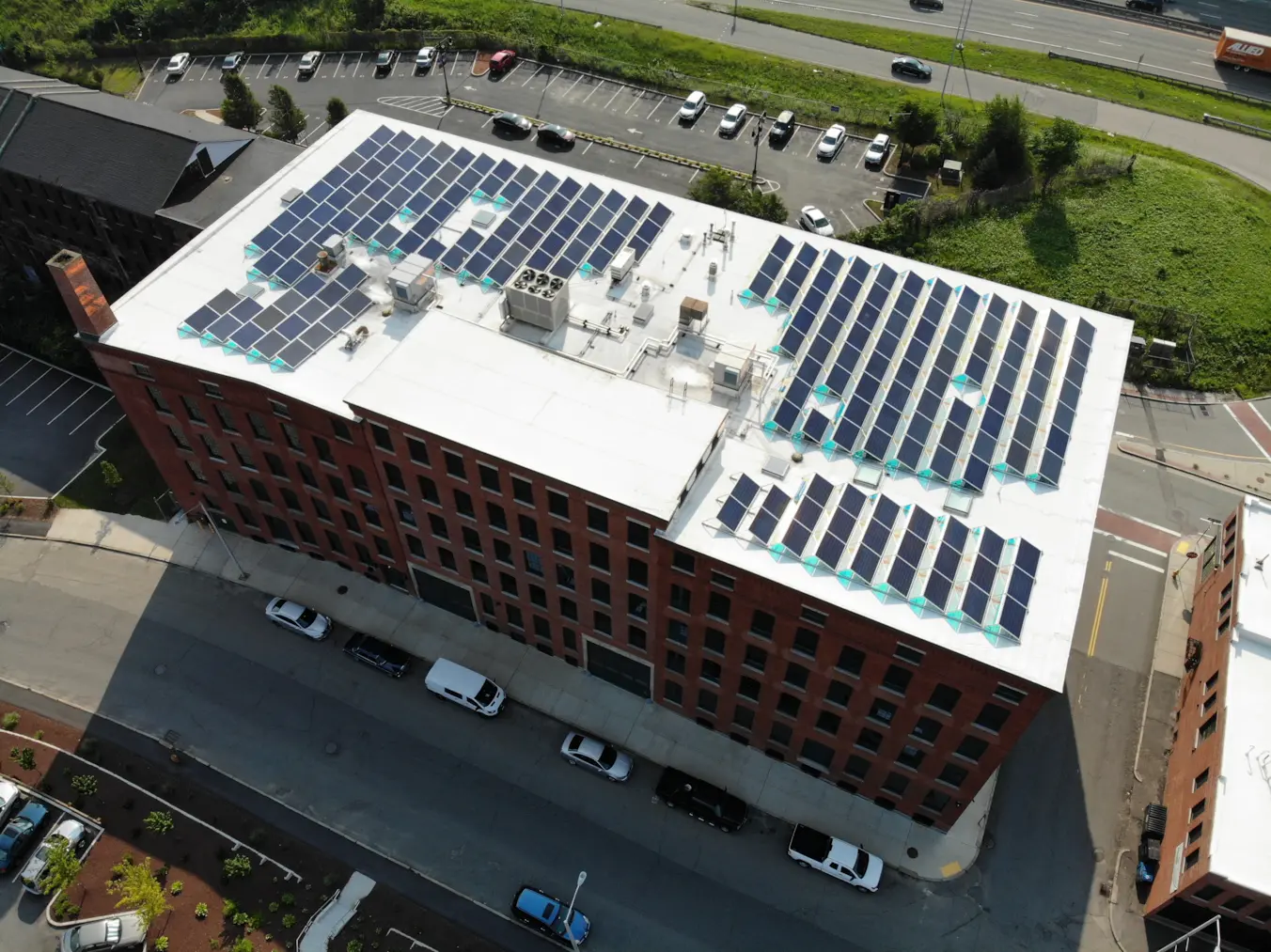
How commercial rooftop solar works
A rooftop system installs solar panels directly on the roof of an existing structure — typically using one of three mounting methods:
- Ballasted systems for flat commercial roofs (no penetrations, weighted in place)
- Mechanically attached racking for pitched roofs
- Flush-mounted systems for low-slope applications
The panels feed into an inverter, which is usually wall-mounted inside the building or in a mechanical room.
Why rooftop solar works well for many commercial properties
- Uses existing structure — no additional land required
- Lower upfront cost per watt in many cases compared to ground-mount
- Keeps parking lots and grounds fully usable
- Straightforward permitting path in most jurisdictions
- Good fit for warehouses, distribution centers, schools, office buildings, and retail centers
The real tradeoffs
Rooftop systems are constrained by the roof itself:
- Roof age and condition must be evaluated before installation
- Shading from HVAC equipment, parapet walls, or adjacent structures can reduce output
- Roof penetrations (for mechanically attached systems) require proper weatherproofing and warranty coordination
- System size is limited to the usable roof area
For properties with large, unobstructed flat roofs, this is often the most cost-effective starting point.
Ground-Mount Solar: Maximum Output for Properties with Available Land
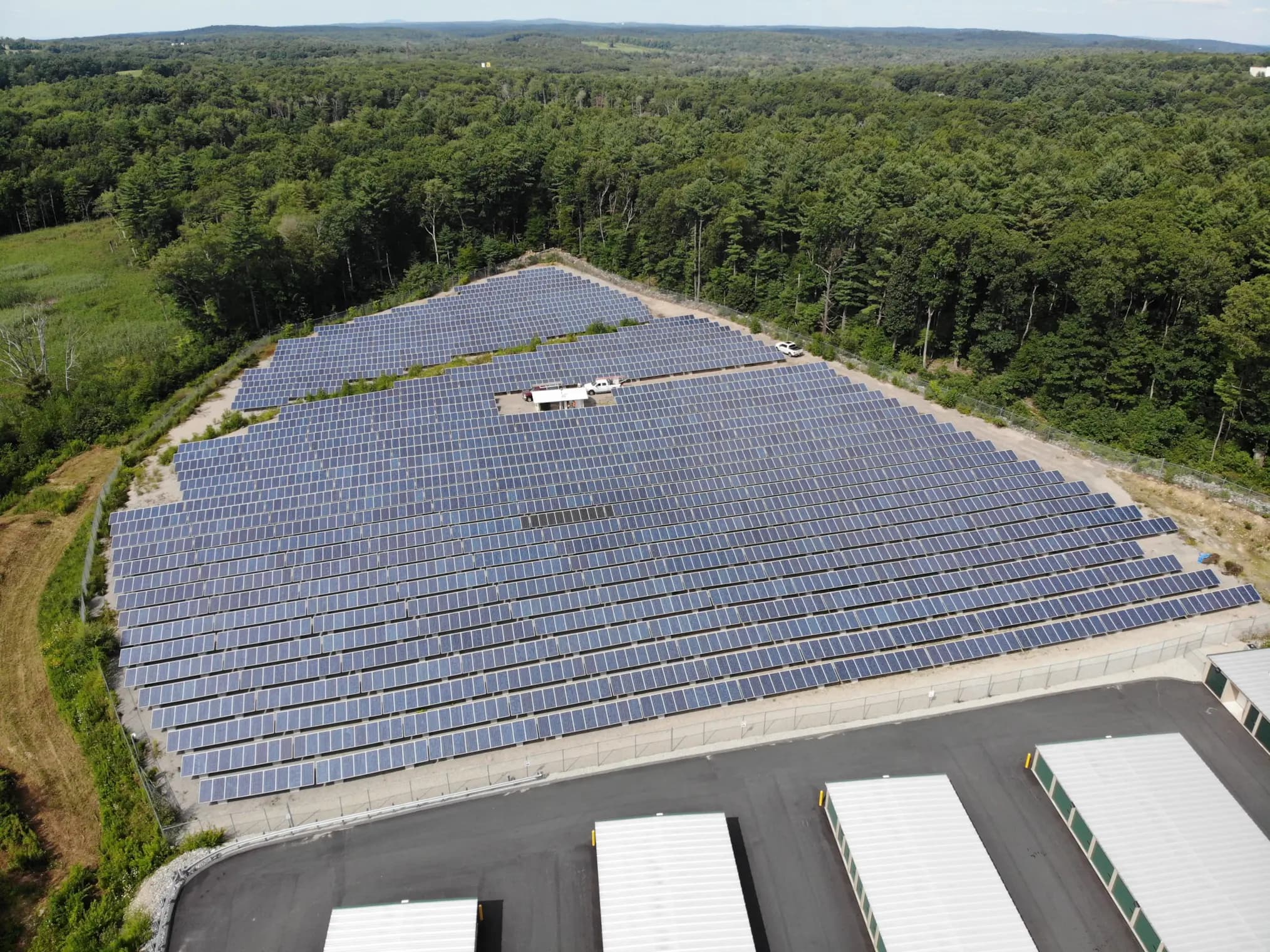
How commercial ground-mount solar works
Ground-mount systems install racking directly into the ground — either using driven piers, concrete ballast, or helical anchors depending on soil conditions and local wind and snow loads.
Panels are arranged in rows at a fixed tilt angle optimized for the property's latitude and energy goals.
Why some commercial properties are better suited to ground-mount
- No roof constraints — system size is driven by energy goals and available land, not building footprint
- Easier access for maintenance and cleaning
- Ideal for agricultural operations, manufacturing facilities, utilities, and any business with open acreage
- Excellent production performance — panels can be oriented and tilted for maximum annual output
- Avoids any interaction with an existing roof system
The real tradeoff
Ground-mount systems require land that isn't being used for other purposes:
- Grading, permitting, and utility interconnection can be more involved than rooftop
- Higher installed cost per project in some cases due to foundation and racking requirements
- Land that goes under panels is typically not usable for other purposes during system life
For properties with the acreage to support it, ground-mount systems often deliver the largest systems and the strongest long-term production numbers.
Solar Carports: Dual-Purpose Infrastructure That Covers More Than Cars

How commercial solar carports work
Solar carports mount panels on elevated canopy structures built over existing parking areas. The parking lot continues to function as normal — the solar array is simply elevated above the vehicles.
Carport systems are available in single-tilt and dual-tilt configurations and can be designed to cover part or all of a commercial parking area.
Why solar carports appeal to certain commercial properties
- Converts existing impervious surface (parking lot) into a productive energy asset
- Provides shade and weather protection for vehicles — a tangible amenity for employees, customers, and tenants
- Excellent fit for retail centers, hospitals, universities, office campuses, and municipalities
- Can integrate EV charging stations directly into the canopy structure
- No roof interaction required — keeps the building envelope untouched
The real tradeoff
Solar carports involve more structural engineering than rooftop or ground-mount:
- Higher installed cost per watt due to the elevated steel canopy structure
- More complex permitting in some jurisdictions
- Site must have adequate pavement condition and layout for canopy foundations
- Wind and snow load engineering requirements are more significant
For properties where the parking lot is one of the largest available surfaces — and where EV charging is part of the long-term plan — carports often justify the added investment.
Rooftop vs. Ground-Mount vs. Carport: Side-by-Side Comparison
| Feature | Rooftop | Ground-Mount | Solar Carport |
|---|---|---|---|
| Primary space used | Roof | Open land | Parking lot |
| Land or roof required | Existing roof | Available acreage | Existing parking area |
| Typical installed cost | Lower to moderate | Moderate to higher | Higher (canopy structure adds cost) |
| System size flexibility | Limited by roof area | High — sized to energy goals | Moderate — limited by parking layout |
| Maintenance access | Requires roof access | Easy ground-level access | Ground-level access under canopy |
| EV charging integration | Indirect | Indirect | Direct — chargers can mount to canopy |
| Best suited for | Warehouses, schools, office buildings | Farms, manufacturers, large campuses | Retail, hospitals, universities, campuses |
Which setup is right for your commercial property?
The right installation type depends on a combination of factors that are specific to your property and business:
- Available roof area, condition, and age
- Available land or parking area
- Total energy goals and system size targets
- Plans for EV charging or battery storage
- Budget structure and financing approach
- Permitting environment in your municipality
In many cases, the best commercial solar solution combines more than one installation type — for example, a rooftop array supplemented by a ground-mount system, or a carport installation paired with EV charging infrastructure.
A thorough site evaluation is the most reliable way to determine what your property can support and what will deliver the strongest return.
Contact us to schedule a free commercial site analysis »
Conclusion: The installation type shapes the entire project
Rooftop, ground-mount, and carport solar systems all convert sunlight into savings — but they do it using very different infrastructure, cost structures, and site requirements.
- Rooftop solar makes the most of existing structure with the lowest incremental land use.
- Ground-mount solar delivers the most flexibility and the largest possible system sizes.
- Solar carports turn parking infrastructure into a dual-purpose energy and amenity asset.
The right choice isn't about which system type is best in general — it's about which configuration fits your property, your goals, and your timeline.